Robert Combas was born in Lyon in 1957 and spent his childhood and adolescence in Sète. Emerging at the end of the 1970s, at a time dominated by conceptual art and marked by a renewed interest in figuration, Robert Combas’s work created a sensation in France when it was first presented to the public during the exhibition Après le classicisme at the Saint-Étienne Museum. Influenced by rock and roll, comic books, graphic arts, and the North African shop signs he observed in Sète, Combas invented a complex iconography that freely blends high culture and popular culture without hierarchy. Using reclaimed materials and cardboard as supports for his expressionist paintings, he developed a visual language inspired in part by the drawings of his adolescence.
He moved to Paris in 1981, and his work was then championed by art critic Bernard Lamarche-Vadel during the exhibition Finir en beauté, alongside works by Hervé Di Rosa, Rémy Blanchard, and François Boisrond. Together, these four artists came to embody what Ben Vautier would call Figuration Libre, a movement destined for major media success. Institutionalized by critics, the term was used to define a spontaneous figurative painting style characterized by vibrant colors and relaxed execution. In reality, however, the label could never fully encompass the diversity and complexity of Robert Combas’s work, which he would continue to develop far beyond this initial recognition in the early 1980s.
Robert Combas’s oeuvre unfolds through a multiplicity of themes that traverse society itself: love, sex, death, mythology, and the lives of saints — subjects explored in depth during his double exhibition in 1991: La Bible at Galerie Beaubourg and Les Saints at Galerie Yvon Lambert. Combas was, and remains, the undeniable leading figure of the Figuration Libre movement. His paintings have always juxtaposed insolence with extraordinary compositional virtuosity. The intricate interweaving of figures, the way every empty space becomes an opportunity for a new pictorial invention, all reveal the remarkable mastery of the painter.
The paradox of his work lies in its ability to measure itself against art history — approached almost as legend — while simultaneously introducing the vocabulary of popular culture, references to great masters, and even television serials, without ever establishing hierarchy between them, but instead treating each with equal virtuosity. His works are often accompanied by written titles whose inventiveness possesses undeniable poetic and humorous force.
Robert Combas’s work has been exhibited in numerous French and European museums, including in Amsterdam, Groningen, the CAPC Musée d'art contemporain de Bordeaux, the Musée d'Art Moderne de Paris, the Contemporary Art Museum of Nîmes, the Seoul Museum of Art, the Manufacture des Gobelins, the Contemporary Art Museum of Lyon (major retrospective in 2012), the Carré Sainte-Anne in Montpellier in 2014 with the exhibition La mélancolie à ressorts, which created a dialogue between the artist’s works and the neo-Gothic church and its stained-glass windows, the Collection Lambert in 2016, and the Grimaldi Forum the same year. Numerous editions and monographs have also been devoted to his work.
It was therefore with absolute inevitability that Robert Combas was entrusted with one of the doors in this exhibition. He whose entire body of work is a vast celebration of excess — of forms, colors, words, and bodies — could only seize this history-laden support with the same fervor he has spent forty years unleashing upon every surface presented to him.
On the worn wood of this Baumettes prison door, Combas did not seek to create beauty. He sought to create truth — and it is precisely this that makes the work so powerful.
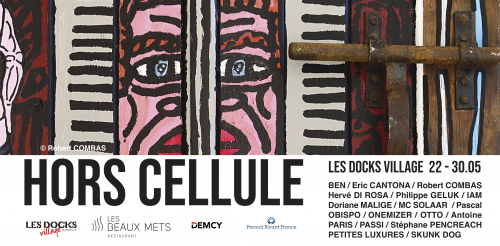
HORS CELLULE
22 May 2026 - 30 May 2026